

If your home loan has been ticking along on the same rate for a few years, you have probably wondered whether it is worth shaking things up. The good news is that working out how to refinance a home loan is less mysterious once you can see the whole sequence laid out. A refinance is really two things happening at once: a discharge on your current loan and a fresh approval on the new one. It only comes together when the timing and the figures on your payout statement line up.
In this post, we walk through the process in the order it happens, from asking your current lender for a better deal, through the application, valuation, unconditional approval, discharge booking and settlement day. We also flag the two or three points where a refinance commonly stalls, so you know what is normal and when to raise a hand.
Time Home Loans compares loans from a panel of 50+ lenders. In most cases there’s no broker fee to pay. Time Home Loans is paid by commission from the lender.
What refinancing a home loan actually means
Refinancing a home loan is not one event. It is two jobs running side by side. Your current lender discharges your existing loan, which simply means closing it. At the same time a new lender approves a fresh one. Until both are ready on the same day, nothing settles and no money moves.
Think of it as two people running errands that must finish at the same time. If one is held up, the whole trip waits. Keeping discharge and approval at the same speed is the real work of a refinance, and why one side going quiet holds up the other.
That is why timing matters more than most people expect. An approved new loan with a discharge that has not been booked is stuck. A discharge booked before the new approval is unconditional can leave you paying fees with no replacement loan in place.
If you searched how do you refinance a home loan, the short answer is that you are managing two timelines and one set of numbers, not filling in one form and waiting. The steps below follow the typical sequence. Our full walkthrough, including when switching isn’t worth it, sits alongside them.
Four words you will hear, explained plainly
As that picture suggests, the jargon comes at you quickly. Here are four terms explained plainly.
Discharge. The formal request that tells your current lender to pay out and close your loan. You sign a discharge authority form, and the lender works to a dated payout figure.
Payout figure. The exact amount needed to close the old loan on a set date. It covers the remaining balance, interest to that date and any fees. It expires, so if settlement moves, the number moves too.
Valuation. An independent assessment of what your property is worth now. The lender arranges it because the property secures the loan. It is not a building inspection and does not comment on your roof.
Unconditional approval. The point where the new lender has finished its checks and will lend. Any conditions have been met, so it is the green light rather than a maybe. Anything short is still provisional.
For why a quick yes can still miss things, read Fast Approval Isn’t a Good Loan.
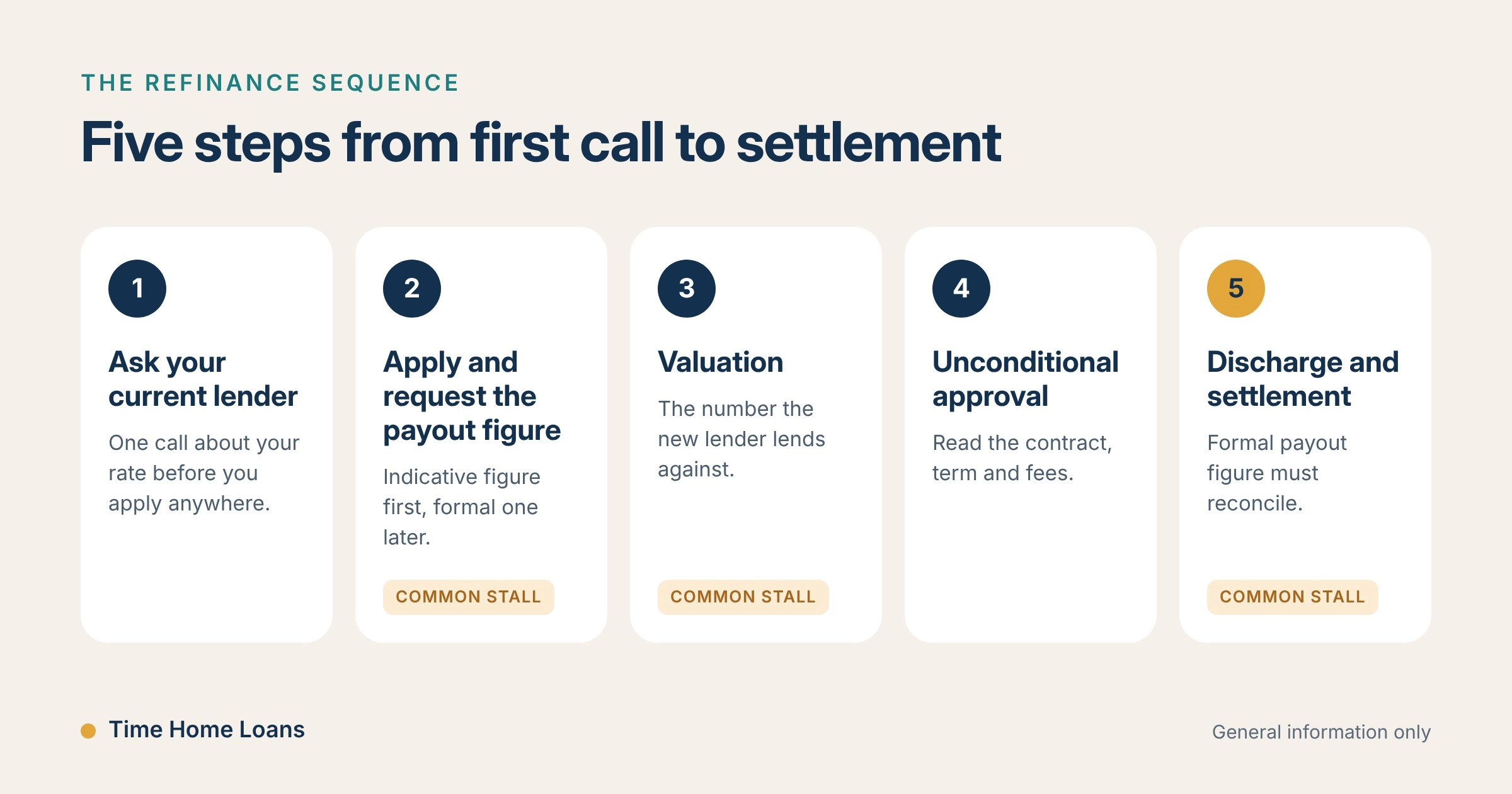
Step 1: ask your current lender before you switch
With those four terms sorted, start with one call before you fill in anything. Ring your current lender and ask what it can do on your rate. ASIC has noted that new customers are sometimes offered terms existing borrowers are not, so the question is worth asking first (ASIC, 10 May 2021, ASIC tips for refinancing). Come prepared: ASIC suggests that having at least 20% equity and a good credit score gives you more room to negotiate, because the lender is weighing up the risk of losing you. Ask what you are paying for too, including a package fee, offset account, redraw facility or a card you never use. A rate reduction can end the process before it starts; staying put can save the paperwork, discharge and fees. If the answer is not good enough, you now hold a real comparison point to take to other lenders. If you want help testing it, read how to choose a home loan broker in Brisbane for 2026.
Step 2: apply with the new lender and pin down the payout figure
With your comparison point in hand, apply to the new lender. The paperwork mirrors a first home loan: identification, proof of income, recent loan statements and rates notice or title details. Two recent payslips usually suit PAYG employees; self-employed borrowers are typically asked for two years of tax returns and notices of assessment. How lenders read self-employed income and add-backs explains complex income.
Your new lender requests a payout figure from your old lender. An indicative number early and a formal figure near settlement are normal. Ask which one you have if unclear.
A broker helps here: Time Home Loans compares loans from a panel of 50+ lenders and handles the process to settlement. In most cases there’s no broker fee to pay. Time Home Loans is paid by commission from the lender.
Applications pause on missing paperwork or a mismatch, such as a payslip showing base pay while your application quotes overtime. One more request is normal; a change in plans is where to ask questions.
Do not request the discharge too early. Booking it before the new loan is solid can trigger fees and leave you without a loan if something falls over. Request it once approval is unconditional and a settlement date is set.
Step 3: the valuation, and what it can change
Once your paperwork is in and the payout figure is requested, the lender arranges a valuation. Your property is the security for the loan, so someone assesses what it is worth today. You will normally not meet them or need to be home. Keeping the place tidy is fine, but it is not an open inspection.
It is also not an appraisal. An appraisal is a real estate agent’s estimate of a sale price, which is a marketing figure. A valuation is the number the lender will lend against and carries more weight in the paperwork. Our glossary covers the Valuation Fee.
Normal is quiet: the valuation is booked and completed within a short window, often with no update until the result lands. Silence means the valuer is working.
Stall point two is a valuation lower than your plans assumed. That can reduce how much you can borrow or push your loan-to-value ratio into a higher pricing tier, changing the deal you were approved for. Don’t assume the refinance is off. Ask about borrowing a little less, adjusting the fixed and variable split or pausing and revisiting later. Nothing should be locked in until you have seen the valuation number.
Step 4: unconditional approval and the fine print
After the valuation, the lender finishes its checks and issues unconditional approval, meaning it will lend. It usually comes in writing with a letter of offer and loan contract attached. Read the contract, not just the first-page rate. Pre-approval differs; our explainer on whether a pre-approval is unconditional finance approval sets out how.
Check the loan term, not only the rate. ASIC notes switching lenders can leave you with a longer term, so you may pay interest longer even at a lower rate (ASIC, 10 May 2021). Weigh cashback against rate and fees over the loan’s life, not the headline (ASIC, 10 May 2021). Check application fees, ongoing account or package fees, your old lender’s discharge fee and any early fixed-rate break costs.
Stall point three: conditions. Approval can arrive with a short list, such as closing an unneeded credit card limit or supplying one more document. A satisfiable list is normal. A condition you cannot meet with anything you hold needs a conversation, not patience.
Hypothetical example. A borrower owes $600,000 with 25 years left and refinances to a new 30 year term. Both loans are at 6.00% per annum. The new loan has a $395 annual package fee and the old lender charges a $300 discharge fee. The monthly repayment falls by about $270, but total interest over the life of the loan rises by roughly $135,000. This is an illustration, not a quote. Other fees may apply.
Step 5: discharge booking, payout figure and settlement day
With unconditional approval in hand, the discharge side gets serious. You sign a discharge authority so your old lender can release the property, then your broker or new lender books a settlement date with both lenders. Both sides need to agree a time.
Your old lender issues a formal payout figure for that date. Check it against the figures used in your approval, because this is where the numbers must reconcile. Lenders can only pay out using the approved amount, so any gap needs fixing before settlement.
Watch for interest to settlement, a redraw balance you have already spent, an annual fee charged that month or a discharge fee. These are common, but each changes the total and should be explained.
On settlement day funds move, your old loan closes, the new loan starts and the mortgage over your title moves between lenders. Keep your phone handy in case a signature is missing. Confirmation normally arrives the same day or next business day.
If the booked day passes without confirmation, ring your broker or new lender. Ask: has settlement completed? If not, what is holding it up and who is fixing it? Our guide to choosing a home loan broker explains how brokers are paid.
Where a home loan refinance commonly stalls
Settlement is where most refinances cross the line, but it is not the only place the process can stall. Knowing the three usual spots tells you when to wait and when to ring.
Paperwork comes first. Applications typically pause on a missing document or an income figure that does not match, like a payslip showing base pay while your application quotes overtime. One more request is normal. Silence after you have supplied everything asked for is worth a call.
The valuation is second. A low number is not a dead end. It is a new set of numbers. Ask what changes, what your choices are and whether the deal you wanted still stacks up before you decide.
Third is the payout figure or a missing signature at settlement. A figure that has moved since approval is the classic delay and a phone call usually sorts it.
All three share the two-track problem. The discharge and the new approval have to land together, so if one side goes quiet the other cannot finish either. Ask for a written timeline with dates and a name beside each step. Regular loan reviews after settlement help you keep on top of it.
After settlement day: the first week and first repayment
Settlement confirmation is not the finish line. In the first week, do these checks in one sitting where you can.
- Confirm your old loan is closed and the new account is active. Check the payout went through for the exact amount on the final payout figure. If it was short or over, ask your broker or new lender now.
- Set up the first repayment and check the due date on your new contract. It may differ from your old date. A missed first payment can show on your credit file.
- Move your salary deposit, direct debits and automatic transfers. Update utilities, insurance, rates and subscriptions too.
- If your loan has offset or redraw, set it up and save the account numbers. These features only help when your money actually lands in them.
- Download the payout statement and final loan documents today. Finding them in three years is harder.
Then you can settle into the new loan with the admin done.
Your next step if you want a hand with the numbers
If you have just finished reconciling two sets of numbers and would rather hand that job to someone else next time, that is where a broker can help. Time Home Loans is a Brisbane-based mortgage broking business working with clients right across Australia, comparing loans from a panel of 50+ lenders.
If you are working out how to refinance a home loan and want someone in your corner, start with a conversation about whether refinancing would actually help in your situation. That happens before you request a discharge or sign anything, so you can still change your mind.
In most cases there’s no broker fee to pay. Time Home Loans is paid by commission from the lender.
The principal broker is Johnathon Reeves (Credit Representative 478570), author of The Great Australian Mortgage Guide. He spent years in banking at NAB before moving into broking, which is useful when you want the lender’s side of the process explained plainly.
The takeaway
Refinancing rewards preparation more than pace. Ask your current lender what it can offer before you apply anywhere and pin down the payout figure early. Treat the valuation and unconditional approval as the checkpoints where the numbers can still shift. File every document you sign as you go, because the first week after settlement is easier when the paperwork is already in one place.
If you would rather hand that reconciliation to someone else next time, Time Home Loans is a Brisbane-based broking business working with clients across Australia, comparing loans from a panel of 50+ lenders. In most cases there’s no broker fee to pay. Time Home Loans is paid by commission from the lender. Start with a conversation about whether refinancing would help in your situation, before you request a discharge.
This article is general information only and does not take into account your objectives, financial situation or needs. Your complete financial situation will need to be assessed before acceptance of any proposal or product. The example above uses an assumed rate for illustration only and is not a quote or an offer of credit. Lending criteria, fees and charges apply. Time Home Loans Pty Ltd ACN 161 695 012, Credit Representative 529395 is authorised under Australian Credit Licence 384324.
Frequently Asked Questions
What does refinancing a home loan actually involve?
Refinancing is two jobs running side by side. Your current lender discharges (closes) your existing loan, while a new lender approves a fresh one. Nothing settles and no money moves until both are ready on the same day.
Should I ask my current lender before switching?
Yes. The post suggests ringing your current lender first to ask what it can do on your rate, since new customers are sometimes offered terms existing borrowers are not. Having at least 20% equity and a good credit score may give you more room to negotiate, according to ASIC. A rate reduction can end the process before it starts.
What is a payout figure and why does it matter?
A payout figure is the exact amount needed to close the old loan on a set date. It covers the remaining balance, interest to that date and any fees. It expires, so if settlement moves, the number moves too. Check it against the figures used in your approval before settlement.
Why shouldn't I request the discharge too early?
Booking the discharge before the new loan is solid can trigger fees and leave you without a loan if something falls over. The post advises requesting the discharge once approval is unconditional and a settlement date is set.
What should I check after unconditional approval?
Read the loan contract, not just the first-page rate, and check the loan term as well as the rate, since switching lenders can leave a longer term and more interest over time. Also check application, ongoing account or package, old-lender discharge and early fixed-rate break fees. Approval may also come with conditions, and a satisfiable list is normal.