

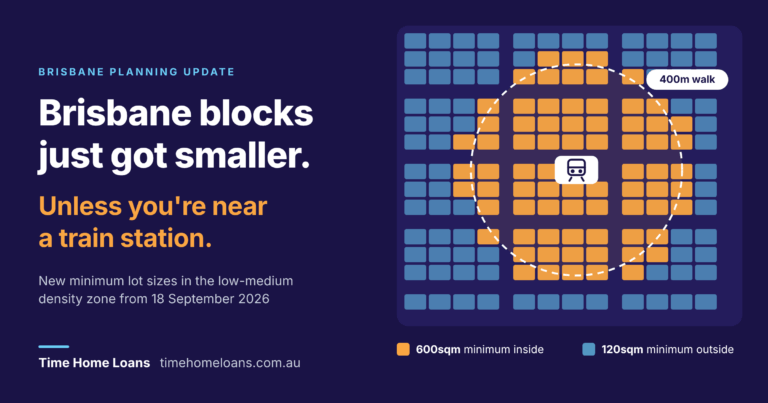
Brisbane City Council’s new planning rules let some lots be as small as 120sqm while lifting the minimum near some transport corridors. For buyers this changes what can be built and financed. For owners it can change subdivision potential and land value. Lenders will look closely at small-lot valuations.
Picture a block of land a little under half the size of a tennis court. That’s the 120sqm minimum lot size that has been all over the news since Brisbane City Council’s new planning rules started on 18 September 2026.
The headline is real. It’s also only half the story (and for a lot of owners, it’s the wrong half).
Our friend George Sourris, Legal Practice Director at Empire Legal, has written one of the clearest breakdowns of the changes I’ve read. You can find his full article here: Brisbane block sizes cut to 120sqm – unless you’re near a train station, then yours just tripled. I’d encourage you to read it.
In this post we’ll cover:
- what changed, in plain English
- the trap most headlines missed
- what it means for your home loan if you’re buying, building or subdividing
What changed
The amendment is called ‘More Homes, Sooner’. It only applies to land in the low-medium density residential zone, which George notes is roughly 14% of Brisbane’s residential land. That’s scattered pockets, not whole suburbs.
Inside that zone, your minimum lot size now comes down to one question. Is any part of your block inside a ‘Key Location’?
A Key Location is generally land within a 400 metre walk of:
- a major public transport interchange
- a stop served at least every 20 minutes on weekdays and every 30 minutes on weekends (7am to 7pm)
- a Principal, Major or District centre or a Mixed use zone
Here’s how it plays out:
Where your block sits | Old minimum | New minimum |
|---|---|---|
3 or 4 storey mix, entirely outside a Key Location | 260sqm or 180sqm | 120sqm |
3 or 4 storey mix, any part inside a Key Location | 260sqm or 180sqm | 600sqm |
2 storey mix precinct | 260sqm | Unchanged |
Low density residential, near a centre | 300sqm within a 200m walk | 300sqm within a 300m walk |
So why would being close to a train station make your minimum bigger? Because Council wants to keep that land in larger parcels that can later hold apartments. It makes sense from a city-planning point of view. It’s a nasty surprise if you bought a block banking on a two-lot split.
Hot Tip: Partial counts as full. If any part of your frontage falls inside a Key Location, Council treats the whole lot as inside. Suburb lists won’t tell you which side of the line you’re on. Only the mapping for your specific lot will.
What it means for your home loan
Buying a block for its ‘potential’
If a listing mentions subdivision potential, ask which rules that claim was written under. Marketing copy can be months old.
This matters for your finance. A bank valuer will usually value the property as it stands today. If you pay extra for potential that no longer exists, the valuation can come in below the contract price and the gap comes out of your pocket.
Hot Tip: Get the zoning checked before you sign. George’s team checks zoning as part of their pre-contract review. We can have your pre-approval sorted at the same time so you’re not racing the clock on finance.
Owners who planned to subdivide
If you were planning a split and now find your block inside a Key Location, the rules may have moved against you.
George explains that owners left worse off can ask Council to assess an application under the old rules. This is called a ‘superseded planning scheme request’ (section 29 of the Planning Act 2016). The window is 12 months, so roughly until 18 September 2027. It’s a request rather than a right and Council can refuse, so get legal advice early.
On the finance side, a subdivision is assessed very differently to a standard home loan. Lenders look at:
- how many lots you’re creating
- whether you plan to sell the new lot or hold it
- your exit strategy if you’re selling
- how much equity you have in the existing property
A two-lot split is often a very different conversation to three or more, which some lenders treat as development finance.
Building on a small lot
Lots under 180sqm need a Development Footprint Plan lodged with the subdivision. If the house is then built in line with that plan, a separate development application for the house isn’t needed. That can simplify the path to a build.
Your construction loan will still need a fixed-price building contract, approved plans and a valuation on completion. Lender appetite for small-lot homes also varies. This is where having 50+ lenders to compare earns its keep.
Things that haven’t changed
- Granny flats and secondary dwellings aren’t affected.
- Character and heritage overlays still apply.
- The general 400sqm minimum in the low density residential zone is unchanged.
In a nutshell
- Check your specific lot. Your suburb won’t tell you.
- Near a station, busy bus stop or major centre? Your minimum may now be 600sqm.
- Buying for potential? Get the zoning checked before you sign.
- Lost subdivision potential? You have until around 18 September 2027 to ask Council to use the old rules.
- Talk to us before you commit to a block, a build or a split so the finance matches the plan.
More reading from Empire Legal
- Queensland title search: what it shows and what it misses
- The $1 that costs QLD first home buyers $30,000
- Sunset clauses in QLD off-the-plan contracts
- Seller disclosure penalties in QLD
Weighing up a block, a knockdown or a subdivision? Call us on (07) 3194 0888 or book a chat. We’ll work through the finance with you and point you to the right people (like George) for the legal side.
This article is general information only. It is not legal, planning, tax or financial advice and does not take into account your objectives, financial situation or needs. Planning information is drawn from Empire Legal and Brisbane City Council as at 23 October 2026. Check the zoning of your property and seek advice for your circumstances. Credit criteria, fees and charges apply. Time Home Loans Pty Ltd ACN 161 695 012, Credit Representative 529395 is authorised under Australian Credit Licence 384324.